





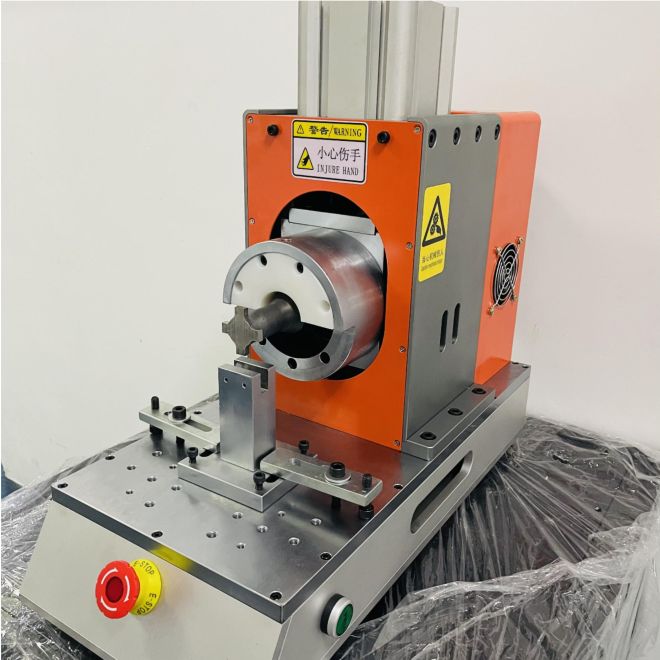
Ultrasonic welding is the use of high-frequency vibration waves to transmit to the surfaces of two objects to be welded. Under pressure, the surfaces of the two objects are rubbed against each other to form fusion between molecular layers. The main components of an ultrasonic welding system include ultrasonic generators, transducers, horns, welding head triplets, molds and frames.
Ultrasonic welding is the conversion of 50/60 Hz current into 15, 20, 30 or 40 KHz electrical energy by an ultrasonic generator. The converted high-frequency electric energy is converted into mechanical motion of the same frequency through the transducer, and then the mechanical motion is transmitted to the welding head through a set of horn devices that can change the amplitude. The welding head transmits the received vibration energy to the joint of the workpiece to be welded, in this area, the vibration energy is converted into heat energy through friction, and the area of the component to be welded is melted. Ultrasound can be used not only to weld metals, hard thermoplastics, but also to process fabrics and films, among others.
The principle of ultrasonic metal welding is a special method of connecting the same metal or dissimilar metal by using the mechanical vibration energy of ultrasonic frequency (over 16KHz). When the metal is ultrasonically welded, neither current nor high-temperature heat source is applied to the workpiece, but under static pressure, the vibration energy of the frame is transformed into friction work, deformation energy and limited temperature rise between the workpieces. The metallurgical bond between the joints is a solid-state welding that is achieved without melting the base metal. Therefore, it effectively overcomes the phenomena of spatter and oxidation generated during resistance welding. Ultrasonic metal welding machine can perform single-point welding, multi-point welding and short strip welding on filament or sheet materials of copper, silver, aluminum, nickel and other non-ferrous metals. It can be widely used in the welding of thyristor leads, fuse pieces, electrical leads, lithium battery pole pieces, and tabs.
Ultrasonic welding has a wide range of applications and long application prospects. For all application markets, ultrasonic welding has its unique advantages-fast, efficient, clean and firm, and has won recognition from all walks of life.
Post time:Jan-30-2023