


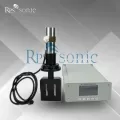
Ultrasonic homogenizer is a device that uses ultrasonic technology to achieve mixing, dispersion and homogenization. The following is a detailed introduction to ultrasonic homogenizer:
Working principle: The working principle of ultrasonic homogenizer is based on the vibration and cavitation effect generated by ultrasound in liquid. When ultrasound acts on liquid, it will produce hundreds of thousands of vibrations per second, which can quickly break up large particles or cells in the material. At the same time, the cavitation effect will produce a large number of tiny bubbles in the liquid, which will grow rapidly and suddenly close under the action of continuous vibration, generating strong shock waves and local high temperature and high pressure environment. This physical phenomenon can effectively disperse the material evenly and improve the quality and stability of the product.
Application fields: Ultrasonic homogenizers are widely used in laboratories and industrial fields, including chemical, dairy, cosmetics, chemicals, energy and food industries. It can be used in various application fields such as cell disruption, emulsification, emulsification dispersion, homogenization and decomposition, degassing, etc. For example, in the chemical field, ultrasonic homogenizers can be used for the preparation of catalysts and the mixing of reactants; in the food industry, it can be used to make yogurt, jam and condiments, etc.
Advantages: Ultrasonic homogenizer has many advantages. First, it can quickly break up large particles or cells in the material, improve the yield and recovery rate of the target component, and thus greatly shorten the experimental or production cycle. Secondly, ultrasound can generate tiny bubbles and shear force, causing strong shear and turbulence inside the liquid, thereby accelerating the mixing and dispersion process. In addition, ultrasonic homogenizer also has the advantages of low noise and good sample protection.

- English
- French
- German
- Portuguese
- Spanish
- Russian
- Japanese
- Korean
- Arabic
- Irish
- Greek
- Turkish
- Italian
- Danish
- Romanian
- Indonesian
- Czech
- Afrikaans
- Swedish
- Polish
- Basque
- Catalan
- Esperanto
- Hindi
- Lao
- Albanian
- Amharic
- Armenian
- Azerbaijani
- Belarusian
- Bengali
- Bosnian
- Bulgarian
- Cebuano
- Chichewa
- Corsican
- Croatian
- Dutch
- Estonian
- Filipino
- Finnish
- Frisian
- Galician
- Georgian
- Gujarati
- Haitian
- Hausa
- Hawaiian
- Hebrew
- Hmong
- Hungarian
- Icelandic
- Igbo
- Javanese
- Kannada
- Kazakh
- Khmer
- Kurdish
- Kyrgyz
- Latin
- Latvian
- Lithuanian
- Lithuanian
- Macedonian
- Malagasy
- Malay
- Malayalam
- Maltese
- Maori
- Marathi
- Mongolian
- Burmese
- Nepali
- Norwegian
- Pashto
- Persian
- Punjabi
- Serbian
- Sesotho
- Sinhala
- Slovak
- Slovenian
- Somali
- Samoan
- Scots Gaelic
- Shona
- Sindhi
- Sundanese
- Swahili
- Tajik
- Tamil
- Telugu
- Thai
- Ukrainian
- Urdu
- Uzbek
- Vietnamese
- Welsh
- Xhosa
- Yiddish
- Yoruba
- Zulu
- Kinyarwanda
- Tatar
- Oriya
- Turkmen
- Uyghur

Application fields and advantages of ultrasonic homogenizer

Table of Contents