





In the production chain of new energy storage devices such as lithium-ion and sodium-ion batteries, the preparation of battery slurry is a key step in determining the performance of the final product. Battery slurry consists of a mixture of active materials, conductive agents, binders, and solvents in specific proportions. Its uniform dispersion and foam-free properties are directly related to the quality of the electrode coating. The presence of bubbles in the slurry can lead to defects such as pinholes and coating gaps in the electrode sheets, reducing the electrode density, affecting the battery's charge and discharge efficiency and cycle life, and even posing safety risks. Traditional defoaming methods, such as vacuum defoaming and the addition of chemical defoamers, are either inefficient and energy-intensive, or may introduce impurities that affect battery performance. Against this backdrop, ultrasonic technology, with its high efficiency, environmental friendliness, and zero secondary pollution, has become an innovative solution for battery slurry defoaming.
II. The Core Principle of Ultrasonic Battery Slurry Defoaming
Ultrasonic defoaming technology leverages the dual effects of cavitation and vibration transmission to efficiently eliminate bubbles in battery slurry. Its core principles can be divided into three key processes:
1. Cavitation Effect: "Micro-Explosion" Bubble Destruction
When ultrasonic waves (typically with a frequency of 20kHz-1MHz) are applied to a battery slurry system, they produce periodic pressure fluctuations within the slurry—alternating between compression and rarefaction phases. During the rarefaction phase, the pressure in the slurry drops sharply, forming a large number of tiny vacuum cavities (cavitation bubbles). These cavitation bubbles rapidly absorb surrounding bubbles (including micron- and even nanometer-sized bubbles), causing their volume to continuously increase. Subsequently, during the compression phase, the pressure in the slurry rapidly rises. Under the pressure, the cavitation bubbles rapidly contract and implode, generating localized transient high pressure (up to thousands of atmospheres) and high temperature (up to thousands of degrees Celsius), accompanied by intense shock waves and micro-jets. This "micro-explosion"-like rupture process directly breaks adsorbed bubbles into extremely small bubble nuclei. These nuclei, being too small to maintain stability, quickly merge with the surrounding slurry or escape from the system, achieving a defoaming effect.
2. Vibration Transmission: Directed Bubble Migration and Escape
When ultrasound propagates through the slurry, it also induces high-frequency vibrations in the molecules and particles within the slurry (the frequency of the vibration matches the ultrasound frequency). This vibration disrupts the stable equilibrium of bubbles within the slurry. Bubbles previously attached to the surface of the active material particles or "bound" by the slurry's viscosity gain kinetic energy under the action of vibration, breaking free from their attachment points and migrating toward the slurry surface. Furthermore, vibration reduces the local viscosity of the slurry, reducing resistance to bubble migration and accelerating bubble aggregation and escape. This vibration-assisted migration effect is particularly important for high-viscosity battery slurries (such as lithium-ion battery cathode slurries, which typically have a viscosity of 1000-5000mPa・s). It can effectively solve the problem of bubble escape from high-viscosity slurries during traditional vacuum defoaming.
3. Secondary Dispersion: Preventing Bubble Regeneration
Unlike chemical defoamers, ultrasonic technology not only defoams but also secondary disperses the particles in the slurry. The ultrasonic vibration and cavitation effect break up any active material and conductive agent aggregates in the slurry, creating a more uniform dispersion. This dispersion reduces the "voids" formed by particle agglomeration. These voids can easily trap air and form new bubbles. The uniform dispersion of particles fills these voids, reducing the likelihood of secondary bubble generation at the source. This achieves the dual effects of "defoaming + dispersion," further improving slurry quality.
III. Core Advantages of Ultrasonic Defoaming Technology
Compared to traditional defoaming methods, ultrasonic technology exhibits significant technical advantages in battery slurry defoaming, which can be summarized in the following four points:
1. High Defoaming Efficiency and Wide Application Range
Ultrasonic defoaming has a short duration (typically a single treatment takes only a few minutes to over ten minutes, significantly less than the tens of minutes required for vacuum defoaming) and can eliminate tiny bubbles (including nano-sized bubbles) that are difficult to remove with traditional methods. Whether it's low-viscosity anode slurry (such as graphite slurry for lithium-ion batteries), high-viscosity cathode slurry, or slurries containing specialized active materials such as hard carbon and Prussian white for sodium-ion batteries, ultrasonic technology delivers efficient defoaming. Applicable slurries range from 100 to 10,000 mPa·s, covering the slurry systems of current mainstream energy storage batteries. 2. Green and pollution-free, ensuring battery performance
Ultrasonic defoaming is a physical defoaming method that requires no chemical defoaming agents, fundamentally avoiding the negative impact of defoaming agent residue on battery performance. The organic components in traditional chemical defoamers may react with electrode active materials or decompose during battery cycling, producing gases and leading to capacity degradation. Ultrasonic technology, on the other hand, only physically breaks bubbles without altering the chemical composition of the slurry, thus maximizing the electrochemical and safety performance of the battery. Furthermore, this technology produces no wastewater or exhaust gas, aligning with the "green manufacturing" development philosophy of the new energy industry.
3. Strong process compatibility and easy integration into production lines
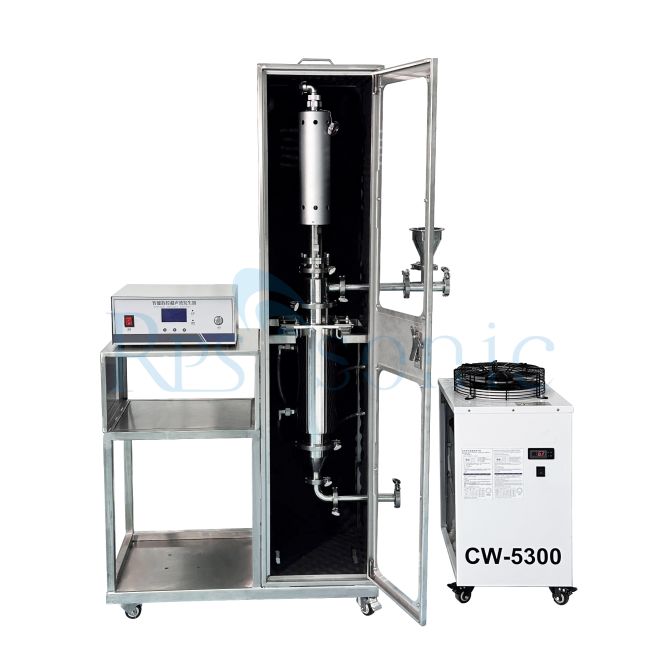
The ultrasonic defoaming equipment is relatively compact and can be flexibly integrated into existing battery slurry preparation production lines. It can be used as a standalone defoaming unit, installed between the slurry mixing tank and the coating machine. It can also be combined with a mixing device to form an integrated "mixing + ultrasonic defoaming" system, enabling simultaneous slurry preparation and defoaming. Furthermore, ultrasonic equipment parameters (such as frequency, power, and processing time) can be precisely adjusted through an automated control system, allowing the defoaming process to be optimized based on the formulation and characteristics of different slurries (such as active ingredient type, viscosity, and solids content), adapting to the flexibility requirements of the production line.
4. Reduced Production Costs and Improved Production Stability
In terms of long-term operating costs, ultrasonic defoaming consumes less energy than vacuum defoaming (which requires a continuous high vacuum level and consumes a lot of energy), and eliminates the procurement and addition costs of chemical defoamers. In terms of production stability, ultrasonic defoaming offers a stable defoaming effect, less affected by slurry batch variations and changes in ambient temperature and humidity. This reduces the electrode scrap rate caused by incomplete defoaming, improving the yield and stability of the production line. Application data from some battery manufacturers shows that the use of ultrasonic defoaming technology has reduced electrode pinhole defect rates by 30%-50%, increased battery cycle life (1C charge and discharge) by 10%-15%, and reduced overall production costs by 8%-12%.