




innovation.

1. Basic principles of ultrasonic indium coating technology
The core of ultrasonic indium coating machine lies in the combination of ultrasonic vibration system and precision fluid control. Its workflow can be divided into the following key steps:
(1) Ultrasonic cavitation effect (Cavitation)
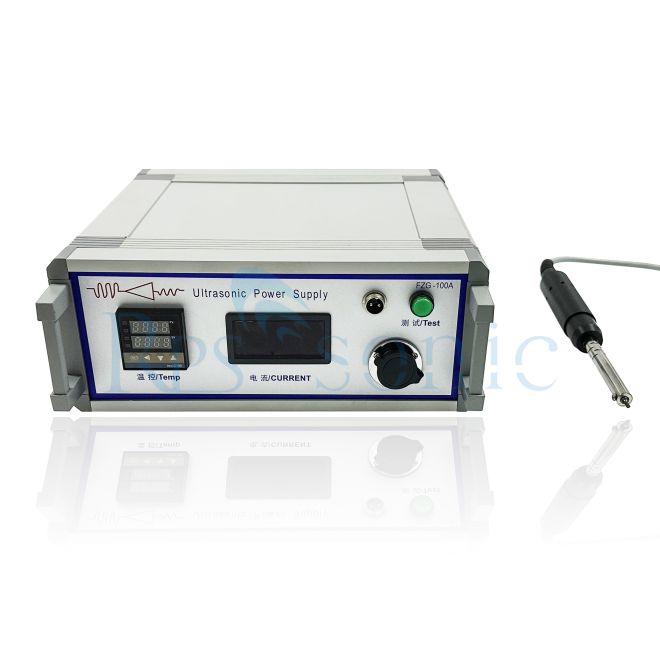
The ultrasonic generator (usually with a frequency of 20kHz~100kHz) converts electrical energy into high-frequency mechanical vibration and transmits it to the indium coating nozzle or substrate surface through the transducer.
The high-frequency vibration causes liquid indium to produce cavitation bubbles. When the bubbles collapse instantly, they release huge energy, breaking the surface tension of the indium liquid, making it easier to wet the substrate and avoiding the "shrinkage" or "agglomeration" phenomenon in traditional coating.
(2) Micron-level atomization spray
Under the action of ultrasonic vibration, the indium liquid is atomized into uniform droplets of micron level (1~50μm) and sprayed onto the substrate surface through a precision nozzle.
Compared with traditional spraying, the droplets of ultrasonic atomization are smaller in size and more concentrated in distribution, thereby reducing splashing and material waste.
(3) Dynamic wetting and leveling control
Ultrasonic energy can reduce the viscosity of the indium liquid and enhance its fluidity, allowing the coating to quickly spread onto the substrate surface into a uniform thin layer (thickness can be controlled between 0.1 and 10 μm).
Some equipment integrates infrared heating or a vacuum environment to further eliminate bubbles and promote metallurgical bonding between the indium layer and the substrate.
2. Three key technologies for achieving high-precision uniform coating
(1) Precise control of frequency and amplitude
Low frequency (20~40kHz): suitable for high-viscosity indium alloys or thicker coatings, with strong cavitation effect, but larger droplet size.
High frequency (60~100kHz): suitable for ultra-thin coatings (such as semiconductor packaging), with finer atomization, but requiring higher energy input.
Adaptive control system: dynamically adjust ultrasonic parameters to ensure consistency by real-time monitoring of coating thickness (such as laser thickness gauge).
(2) Coordinated control of multi-axis motion platform
High-precision indium coating machines are usually equipped with CNC motion platforms or robotic arms to achieve uniform coverage of complex curved surfaces (such as solar cell grid lines and chip pads).
For example, in photovoltaic heterojunction (HJT) cells, ultrasonic indium coating can accurately fill micron-level electrode patterns to avoid short circuit risks.
(3) Environment and material optimization
Inert gas protection: prevents indium oxidation (especially in high-temperature processes).
Substrate pretreatment: Increase surface energy and enhance adhesion of the indium layer through plasma cleaning or chemical activation.
3. Typical application scenarios
Photovoltaic industry: HJT battery electrode indium coating to improve photoelectric conversion efficiency.
Semiconductor packaging: Low-temperature defect-free indium plating of chip interconnect pads.
Aerospace: High-reliability indium plating is used for satellite thermal interface materials (TIM).