


Ultrasound-Assisted Extraction (UAE) is a technology that uses ultrasonic cavitation effect to efficiently extract active ingredients from plants. It is especially suitable for the extraction of polysaccharides, phenols, triterpenes and other active ingredients in mushrooms. The following is its typical process and key points:
1. Raw material pretreatment
Washing and drying: Fresh mushrooms are washed and sliced or cut into pieces, usually freeze-dried (to retain active ingredients) or hot air dried (lower cost).
Crushing and sieving: After drying, crush to 40-80 mesh (particle size of about 0.2-0.5mm) to increase the contact area.
2. Ultrasonic extraction steps
Equipment selection: probe ultrasonic instrument (direct contact, high intensity) or tank ultrasonic instrument (indirect treatment, large batch), the frequency is usually 20-40kHz.
Solvent selection:
Water: suitable for polysaccharides (such as Lentinan), temperature 60-80℃.
Organic solvent: ethanol (50-70%) is used for phenols and triterpenes (such as ganoderic acid), and the concentration needs to be controlled to avoid protein denaturation.
Acid-base assistance: dilute acid/base can destroy cell walls (such as chitin) and improve the extraction rate.
Parameter optimization:
Power: 100-500W (too high may cause degradation).
Time: 10-60 minutes (too long may cause oxidation).
Temperature: usually controlled at 50-70℃ (high temperature requires condensation and reflux to prevent volatilization).
3. Post-treatment
Solid-liquid separation: centrifugation (4000-8000rpm, 10 minutes) or filtration (0.45μm membrane).
Concentration and purification: rotary evaporation concentration, further purification of target components by macroporous resin, dialysis or column chromatography.
Drying: freeze drying (for heat-sensitive components) or spray drying (large-scale production).
4. Advantages and precautions
Advantages:
Extraction time is shortened by 50-70%, and solvent usage is reduced by 20-50%.
Polysaccharide yield can be increased by 15-30% (compared with traditional hot water extraction).
Precautions:
Ultrasound may generate reactive oxygen species (ROS), and antioxidants (such as 0.1% vitamin C) need to be added.
Some components (such as proteins) may be denatured due to cavitation effects, and parameters need to be optimized.
Application example: Lentinan polysaccharide extraction
Conditions: water as solvent, solid-liquid ratio 1:30, 60℃ ultrasonic for 40 minutes (300W).
Results: The polysaccharide yield can reach 8-12%, significantly higher than the 5-7% of the traditional method.

- English
- French
- German
- Portuguese
- Spanish
- Russian
- Japanese
- Korean
- Arabic
- Irish
- Greek
- Turkish
- Italian
- Danish
- Romanian
- Indonesian
- Czech
- Afrikaans
- Swedish
- Polish
- Basque
- Catalan
- Esperanto
- Hindi
- Lao
- Albanian
- Amharic
- Armenian
- Azerbaijani
- Belarusian
- Bengali
- Bosnian
- Bulgarian
- Cebuano
- Chichewa
- Corsican
- Croatian
- Dutch
- Estonian
- Filipino
- Finnish
- Frisian
- Galician
- Georgian
- Gujarati
- Haitian
- Hausa
- Hawaiian
- Hebrew
- Hmong
- Hungarian
- Icelandic
- Igbo
- Javanese
- Kannada
- Kazakh
- Khmer
- Kurdish
- Kyrgyz
- Latin
- Latvian
- Lithuanian
- Lithuanian
- Macedonian
- Malagasy
- Malay
- Malayalam
- Maltese
- Maori
- Marathi
- Mongolian
- Burmese
- Nepali
- Norwegian
- Pashto
- Persian
- Punjabi
- Serbian
- Sesotho
- Sinhala
- Slovak
- Slovenian
- Somali
- Samoan
- Scots Gaelic
- Shona
- Sindhi
- Sundanese
- Swahili
- Tajik
- Tamil
- Telugu
- Thai
- Ukrainian
- Urdu
- Uzbek
- Vietnamese
- Welsh
- Xhosa
- Yiddish
- Yoruba
- Zulu
- Kinyarwanda
- Tatar
- Oriya
- Turkmen
- Uyghur

How to use ultrasonic homogenization equipment for mushroom extraction?
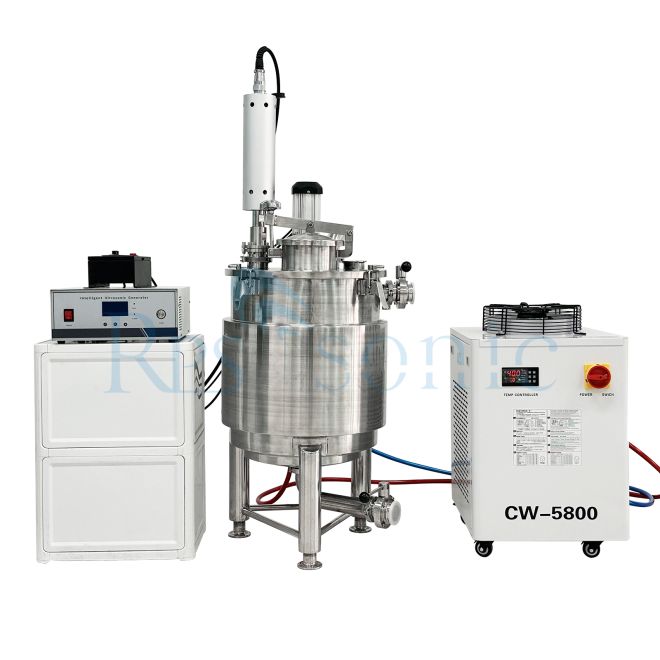
Table of Contents